



-
- Website Specials
- New for 2025!
- Tulips
- Narcissi
- Allium
- Anemone blanda
- Brodiaea
- Camassia
- Chionodoxa
- Corydalis
- Crocus
- Dichelostemma
- Eranthis
- Eremurus
- Erythronium
- Fritillaria
- Galanthus
- Gladiolus
- Hyacinths
- Hyacinthoides
- Ipheion uniflorum
- Dutch Iris
- Rock Garden Iris
- Ixiolirion
- Leucojum Aestivum
- Muscari
- Ornithogalum
- Oxalis
- Puschkinia
- Scilla
- Triteleia
- Lilies
- Peonies
- Tender Bulbs
- Anemone Giants
- Tecolote Ranunculus
- Freesias
- Paperwhites
- Amaryllis
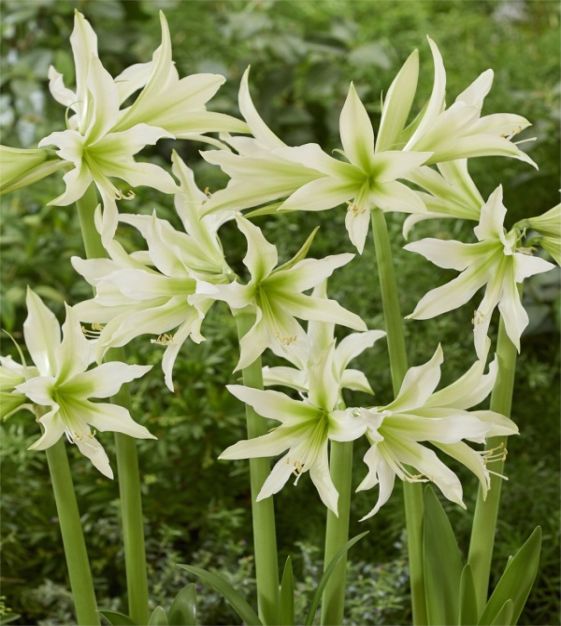
Amaryllis White Nile
This elegant, star-shaped enchantress is chartreuse-ivory with a beguiling lime-green starburst. It will produce four to six flowers per stem with one to two, 18” to 24” stems. They come in a mesh bag. Bulb size: 24/26 cm.
Amaryllis growers in the Netherlands have been breeding and propagating new varieties of Amaryllis for outdoor growth since the 1980s. We are calling these varieties “semi-hardy” Amaryllis because they are good for growth outdoors in Horticultural Zones 7B through 10, withstanding in-ground temperatures of 35°F. In these zones only, they are terrific for display beds, cutting gardens and outdoor containers. They are as perfect for growing in pots indoors and for cut-flower bouquets as are traditional Amaryllis.
Amaryllis are The Art & Soul of Winter.
Amaryllis growers in the Netherlands have been breeding and propagating new varieties of Amaryllis for outdoor growth since the 1980s. We are calling these varieties “semi-hardy” Amaryllis because they are good for growth outdoors in Horticultural Zones 7B through 10, withstanding in-ground temperatures of 35°F. In these zones only, they are terrific for display beds, cutting gardens and outdoor containers. They are as perfect for growing in pots indoors and for cut-flower bouquets as are traditional Amaryllis.
Amaryllis are The Art & Soul of Winter.
- Information
Miscellaneous Narcissi
Not to be overlooked, these varieties are in their own little group because they don't quite fit into any of the R.H.S. divisions.
All Narcissi tolerate a wide range of sunlight from full sun to semi-shade. Varieties with pink cups should be grown in areas of filtered sunlight. Narcissi prefer well-draining soil, hate to get wet feet and love to be fed with a 4-10-6 or 5-10-5 granular organic flower bulb fertilizer three times a year. Allow the foliage to thrive and die back naturally without braiding or premature removal. Bulb size: 12/14 cm, unless otherwise noted. Bloom time in a horticultural zone 5: March/April. Plant 6" deep and 6" apart. Horticultural zones 5-8. Height: 6" to 14", depending upon variety. Narcissus classification: Royal Horticultural Society Division 12.
Narcissi are The Art & Soul of Spring.
Narcissus Horticultural Tips Narcissus Forcing Tips
Miscellaneous Narcissi
Not to be overlooked, these varieties are in their own little group because they don't quite fit into any of the R.H.S. divisions.
All Narcissi tolerate a wide range of sunlight from full sun to semi-shade. Varieties with pink cups should be grown in areas of filtered sunlight. Narcissi prefer well-draining soil, hate to get wet feet and love to be fed with a 4-10-6 or 5-10-5 granular organic flower bulb fertilizer three times a year. Allow the foliage to thrive and die back naturally without braiding or premature removal. Bulb size: 12/14 cm, unless otherwise noted. Bloom time in a horticultural zone 5: March/April. Plant 6" deep and 6" apart. Horticultural zones 5-8. Height: 6" to 14", depending upon variety. Narcissus classification: Royal Horticultural Society Division 12.
Narcissi are The Art & Soul of Spring.
Narcissus Horticultural Tips Narcissus Forcing Tips
